Thursday, August 13, 2020

Delicious, Easy-To-Make Smoothies For Rapid Weight Loss, Increased Energy, & Incredible Health!

 how to lose weight.

weight loss.

low carb.

how to lose weight fast.

nutrition.

mediterranean diet.

atkins diet.

low carb diet.

What Makes The Smoothie Diet Different?

This Is NOT just a big book of smoothie recipes. You're getting the same proven 3-Week weight loss and health improvement program I share with my private clients. The secret that makes the Smoothie Diet so effective is the Custom 3-Week Weight Loss Schedule. All the smoothies are given in a very specific sequence and frequency to maximize your results. For example the nutrient and ingredient ratios vary week to week to make sure the weight keeps coming off and stays off.

I’ve used my knowledge as a Health Coach and what I’ve learned from all my clients to make sure this program delivers rapid results. I have meticulously researched specific ingredients and nutrient properties to maximize the effectiveness of this program. All you have to do is replace certain meals with the smoothie recipes I provide and then watch as the pounds melt effortlessly off your body and your energy levels skyrocket

Click Link IS HERE

THE SMOOTHIE DIET 21-DAY PROGRAM

If you're looking for a complete life transformation over the next 3 weeks then you’re in the right place! Whether you need to lose the last 5-10 lbs or you want to get rid of 40lbs or more, this will work for you. This diet is extremely flexible so even though this program is 21 days you can continue using it for as along as you want to lose as much weight as you want and I explain exactly how.

Dramatic weight loss is only one of the numerous benefits you’ll get from this diet. How would you like more energy, clearer skin, better sleep, sharper thinking, stabilized blood sugar, and more? You are only 21 days away...

  • You're getting the FULL 21-DAY WEIGHT LOSS AND HEALTH IMPROVEMENT PROGRAM I regularly use with my private coaching clients.
  • Over 36 Delicious Fat-Melting Meal-Replacement Smoothie Recipes
  • Shopping Lists For Each Week To Make It Super Simple To Get Everything You Need
  • Smoothie Making Tips & Prep Guide To Make Sure there is ZERO trial and error and to ensure you spend less time in the kitchen and more time enjoying your new confidence and energy levels!


Still Have Questions? I've got you covered!

I need to lose more weight, how do I continue after the 21 days?

The best part of The Smoothie Diet is that you can use it for as long as you need, to lose as much weight as you want. I make it super simple to continue using everything you learn in the first 3 weeks to extend the program for the next few weeks or even months. And each additional week will be just as enjoyable as the first three! My goal is to give you all the tools you need to continue losing weight and getting healthy for as long as you need to.

Won't I just gain all the weight back?

Unlike other diets, this is not a “quick-fix”. 21 days is only the beginning to a lifetime of better health and a slimmer body. The #1 comment I get on The Smoothie Diet is that after a few weeks, the cravings for sweets and junk foods have essentially disappeared. This makes it very easy to keep the weight off. I also show you exactly how to transition back into your regular eating patterns after the 21 days while still incorporating smoothies into your diet to keep the weight off. In fact, most people love the smoothies so much they don’t want to give them up after the 21 days! As some of my clients have said, this is a complete life-transformation program.

I have type-2 diabetes, will this work for me?

Fresh, whole fruits, as well as blended green smoothies not only provide a healthy way for diabetics to get more fruits and vegetables in their diet, green smoothies also may help reverse some of the diet and lifestyle problems that exacerbate diabetes, or contributes to its progression. The great thing about the Smoothie Diet is that it kicks off a chain-reaction of lifestyle changes that reduce or eliminate the factors that exacerbate the disease, and reverses the condition in some individuals. Please note that while I am a nutrition expert, I am not a doctor. If you have diabetes or ANY other health condition, you should always consults with your doctor first before making any dietary changes.

I don't have a lot of time in the day, is this hard to follow?

If you don’t have a lot of time in the day, then this program is PERFECT for you. My ideal customer is a busy mom who works, goes to school, has errands to run, kids to drop off/pick up, etc. I designed this program to be super simple and take minutes a day. I even provide tips on how to cut corners to shave some valuable extra minutes off your smoothie prep. The recipes are quick to make and you can either enjoy them right after you make them or take them with you. You’ll always have a delicious, filling meal with you. And if you can press one button on your blender then you can follow this program :)

Do I need an expensive blender or are the ingredients hard to find?

With the increased popularity of smoothies, blender prices have gotten very competitive. The most important thing is to have a blender with a strong motor. While the bender you have now will probably work just fine, If you are serious about making a big change in your health, then I show you some of the top-of-the-line blenders. But I also show you cheaper models that will work just fine and are under $50. The ingredients are not hard to find and if they are, I provide a full “Swap List” that shows you easy substitutes to use if you can’t find something.

Is there anything that comes in the mail?

This is a fully digital product. You will not receive anything in the mail. The great thing about this is that you will have access to it in minutes. You don't have to wait for anything to arrive on your doorstep. I want to harness the excitement you're feeling right now and get you started right away. You can even do your week 1 shopping today and start tomorrow…or start today! The files are in PDF format. After you checkout, you will automatically be taken to a page where you can download and view everything on your computer, tablet, or smartphone. For those of you who would prefer a printed book, the Quickstart Bonus is designed for this. It is a 20-page shortened version of the main guide that can be printed out and followed just like a printed book.

What if it doesn't work for me?

If for some reason this program does not work for you even though you have followed it exactly as I have laid out, I have no problem giving you a full refund. I'll even cover you for a full 60 days so if you are unhappy for any reason over the next 2 months, you get your money back. If you are not happy with the program, then I don’t want you to have to pay for it. I believe in building relationships with my customers and your satisfaction is my #1 priority.


Daily Keto Meals™ Makes Keto Easy, Fun And Fast

Flat belly Challenge

Weight Loss

Flat Belly Workout

For Woman Loss Weight

Belly fat

Dear friend,

My name is Caleb O’Dowd. I’m the Founder of Daily Keto Meals. Our mission is to make your journey to success on Keto easy, fun and fast.

Day after day I hear dozens of people voice the following problems (perhaps one or more of them apply to you.)

► I don’t know how to figure out my macros.
► I can never keep straight how much protein, fat, or carbs I’m supposed to eat.
► Keto food is boring.
►Everyone else is losing weight on Keto but me.
► I lost some weight in the beginning but now I’ve stalled for a long time.

I want you to know I take these problems seriously.

Sometimes I spend time awake at night realizing how badly people want to succeed at Keto but get frustrated.

Click link IS HERE

Confusion Everywhere

Look there’s a lot of information out there about Keto. There are tens of thousands of videos on YouTube. There are probably more than 100 Keto groups on Facebook.

And guess what.

They all contradict one another.

This one says vegetables don’t count in your macros. Another one says they do count.

This one says you can have all the protein you want. This one says protein turns into sugar or fat.

This one says drink protein shakes and another one says they spike your insulin.

So I understand why people are so frustrated and upset.

Keto’s Dirty Little Secret

If I can be perfectly frank I see that only a tiny minority stick with Keto long term.

It’s not because they aren’t motivated or don’t really want to lose the weight.

It’s not because there isn’t enough information about Keto out there. In fact, there are billions of pages out there about Keto.

It’s not that Keto is more expensive. Just add up the snacks, sodas, and shakes people ate before Keto and compare.

It’s because of three reasons:

  1. People think they have to be hungry on Keto. No one wants to be hungry.
  2. They think researching what they should eat takes up too much time.
  3. They find calculating macros and accounting for every morsel that goes into their mouth too complex.

Keto Shouldn’t Be Difficult

I know that people start Keto with the best of intentions. They watch their favorite celebrities Katie Couric, Halle Berry, Kourtney Kardashian, Gwyneth Paltrow, Vinny Guadagnino, Mick Jagger, LeBron James, Megan Fox and many more shed weight effortlessly on Keto. Then they ask the question…

Why Not Me?

Nearly everyday I hear people report they “fell off the wagon” or they had a “cheat day.” Then they feel badly about themselves and throw in the towel and tell their friends “Keto doesn’t work.”

But there’s a secret to Keto Success I want to share with you.

► It’s not about cutting back or counting your calories.

► It’s not about eating fat bombs to get your fats in.

► It’s not about taking those expensive Ketone products.

► It’s not about using a food tracking app every day.

► It’s not about denying yourself the foods you love.

On the contrary…

Keto Should Be Simple!

Let me just say you can lose all the weight you want on Keto without a struggle, without starving yourself, and without denying yourself your favorite foods.

So the first thing we need to do is get rid of the “deprived” mentality once and for all.

I want you comfortable with the idea that Keto isn’t a “starve yourself thin” program. You can eat simple to prepare, delicious Keto foods, every single day on your journey.

And you don’t have to eat with your Keto diet app open, tracking everything you eat.

I promise you there’s a better way.

Let Me Do All The Work For You!

Most people I meet don’t have the time to plan out what they want to eat for the week.

They end up eating the same meals again and again, get bored, and begin to cheat.

They don’t fall off the wagon. They leap off because they’re “hangry” – they are hungry and angry at the same time.

So I’d like to do all the work for you to free you from the hard part of Keto.

Just Imagine…

Forget boring eggs for breakfast. You’ll love my pumpkin waffles, broccoli and cheese muffins, blueberry muffins, steak and eggs, sausage and egg breakfast sandwiches, pancakes and much more.

Lunches will make your mouth water with creamy pesto shrimp with zoodles, salmon burgers, cobb salad with cilantro-lemon dressing, feta meatloaf and green salad, taco salad with beef and other tasty, simple to prepare dishes.

Dinners will be filling, delicious, and nutritious. Choose from spaghetti squash with meat sauce, pan seared scallops with mac and cheese on the side, herbed butter salmon, creamy Italian garlic chicken and more.

► Yes you can eat these delicious foods and lose weight!
► Yes you can forget about counting calories or fats, proteins or carbs!
► Yes you can succeed at all your weight loss goals!
► Yes you can say goodbye to boring food – FOREVER!

That’s why I’ve created something special and unique…


Friday, May 22, 2020

Kachin Diabetes Solution – 2020 Top Diabetes Health Offer. Huge Epc’s


Dr. Bernstein’s Diabetes Solution

Achieving normal blood sugars for diabetics with the aid of a low carbohydrate diet and exercise is the focus of Dr. Bernstein’s Diabetes Solution, and The Diabetes Diet, Dr. Bernstein’s Low-Carbohydrate Solution.

Whether you are newly diagnosed or a lifetime veteran of Type 1 or Type 2 Diabetes, Dr. Bernstein, a renowned and even revolutionary figure in diabetes treatment and diabetic himself, will show you how you could stop the roller-coaster swings in your blood sugars, steady your glucose levels, reduce your insulin intake and enjoy the same level of good health that people without diabetes have.

Books by Richard K. Bernstein, M.D., F.A.C.E., F.A.C.N., F.A.C.C.W.S.


BUY NOW 


RKB, Office 2014Dr. Bernstein’s Amazing Story with Diabetes

Diagnosed with type 1 diabetes in 1946 at the age of 12, Dr. Richard K. Bernstein never set out to be a doctor. Not only that but according to statistics from the American Diabetes Association, he should have been long dead by now.

That he is very much alive and, in fact, in excellent health, can be attributed to two primary causes. The first is that he was originally trained as an engineer and attacked his disease as a problem to be solved and not a condition to be treated. The second is that he was fortunate enough to still to be alive when the first blood glucose meters arrived on the scene.

He is the first diabetic ever to monitor his own blood sugars.

These facts combined with Dr. Bernstein’s sheer determination to solve the problem of diabetes led to his revolutionary method of blood glucose normalization, which he demonstrates in the groundbreaking, perennial bestselling book, Diabetes Solution.

In 1969, after following ADA guidelines for more than twenty years, Dr. Bernstein had many of the debilitating complications of the disease. Sick and tired of being at the mercy of his disease, he obtained one of the early blood glucose meters. Hardly the cheap and common instrument it is now, the device was intended for a very small and specialized niche: To help keep hospitals from inadvertently allowing comatose diabetics to die at night when their labs were closed, because a diabetic in a coma smells of ketones and can be easily mistaken for someone who has been drinking heavily.

Dr. Bernstein obtained one of the devices at the princely sum of about $700—today, based on inflation, that’s nearly $5,000. Dr. Bernstein used himself as a guinea pig and began testing his blood glucose throughout the day, hoping to discover what made it go up and down. After considerable trial and error, not to mention research, he discovered that he could normalize his blood glucose through diet, exercise and medication—and that he could help others do the same.

This was his elegant, landmark breakthrough: The only difference between a diabetic and a non-diabetic is high blood sugars. All of the complications of diabetes are caused by high blood sugars. Therefore, if you can normalize blood glucose, you can prevent the complications or make them go away, which is exactly what a cure would do.

Except that when the then-engineer Richard Bernstein tried to persuade the medical community that he had found the answer, the medical community roundly ignored him—even told him that it was impossible. So, in his mid-forties, he decided the leave his successful career in business and go to medical school.

Even when the first edition of his landmark Diabetes Solution came out in 1997, Dr. Bernstein was still battling established notions about diabetes treatment. That’s less true today, but it’s also less important today in the era of consumer-directed healthcare plans and readily available health information on the Web.

Today, many thousands of patients and readers later, Dr. Bernstein continues to see and train patients, maintains a busy schedule that includes a monthly question-and-answer teleconference, and continues to refine his cutting edge program of blood glucose normalization. He reaches more patients than he ever could have back when he first opened his practice—and slowly, too slowly perhaps, the standard of care has been changing to mirror his ideas.

The simple, straightforward program that is detailed in his book Diabetes Solution, is based in good nutrition, healthy exercise, and (where necessary) small doses of medication. Dr. Bernstein will show you what he has learned during his 69 years of living with Type 1 diabetes and how, through intense research and experimentation he developed his unique but simple plan which has helped countless diabetics. “It’s astonishing no one thought of it before,” he says. “Many in the field of diabetes care still do not accept it!” But those who follow the program stick with it for one reason: it works!

Developed almost completely outside the mainstream of diabetology, his low carbohydrate solution has helped patients of various ages and symptoms, young and old. Achieving normal blood sugars is not as difficult as one might believe, and he has included case studies of patients who have experienced dramatic improvements in their diabetes.

Perhaps you or your loved ones may already be suffering from some complications of diabetes, such as gastroparesis, heart disease, kidney disease, retinopathy, frozen shoulder, etc.

Check out Dr. Bernstein’s insights on Controlling Blood Sugars.

Friday, May 01, 2020

Muscle Imbalances Revealed – Lower Body System

A while back, several industry notables launched a webinar series called Muscle Imbalances Revealed.  To be honest, I had been approached about contributing on the project, but just didn’t have the time to give the project the attention it deserved.  Luckily for all of us, though, Rick Kaselj went through with pulling this together, and an excellent resource was born.

muscle-imbalances-revealed-open-package-300x201

The product consists of seven webinars all aimed at identifying and correcting muscular imbalances in the lower body.  Contributing to the project were Kaselj, Mike Robertson, Bill Hartman, Dean Somerset, Kevin Yates, and Eric Beard.  Rather than go into a ton of detail on each presentation (and I did take quite a few notes on each), I’ll highlight the components from the set as a whole that stood out for me.

1. Rick Kaselj had some excellent information on the incidence of knee injuries and surgeries across various populations; they are definitely statistics to which I’ll be referring for future blogs and presentations.  His presentation on ACL return-to-function would be a tremendously valuable resource to any trainer or strength and conditioning coach who has never gotten a post-ACL athlete right after discharge from therapy.  I remember when I saw my first post-ACL case; I literally went home and did 4-5 hours of research that night just to make sure that I was up to speed on where that female athlete should be, and what her restrictions were.  Scarily, we knew a lot less back then than we do now – and that’s what makes Rick’s presentation so valuable: it’s all the latest info all in one place.  My only small criticism is that it could have used some more videos within the presentation, but that’s nothing to write home about in light of the content he provides.

acl

2. Bill Hartman dropped some serious knowledge bombs, as only Bill can.  I found that I took the most notes during Bill’s presentation.  A few things that stood out:

a. Don’t just think of it as thoracic mobility; think of it as rib mobility, too.
b. A lot of people overlook how much exhaling during a thoracic extension drill can improve the efficacy of the exercise.  Try it!
c. Bill went to great lengths to discuss the differences between mobility (“the ability to achieve the desired posture or movement”) and regular ol’ flexibility.
d. He worked in a bit of Postural Restoration Institute flavor, and it was nice to see which specific exercises he was using the most in a group training setting, as we do quite a bit of it ourselves.
e. Bill demonstrated the quadruped extension-rotation with the arm maximally internally rotated behind the back; it’s one I really like, and we’ll be using it selectively with a few of our clients.  T-spine mobility is so essential to glenohumeral internal rotation range-of-motion, and it seems like internal rotation is more quickly impacted than external rotation – so it makes sense to mobilize in this position.

f. While emphasizing ankle mobility, we can’t overlook the importance of strengthening the anterior compartment of the lower leg.

3. Mike Robertson was excellent as well, although I didn’t take quite as many notes as I did with Bill simply because I see and speak with Mike more often.  I’ve written quite a bit about how the subtalar joint is a “torque converter” where pronation drives tibial/femoral internal rotation and adduction, plus anterior pelvic tilt.

pronation

In this presentation, Mike does a great job of taking it a step further and talking about how dysfunction at the pelvis can drive pronation from the top down; poor hip strength and mobility can definitely wreak havoc on the lower extremity.  He also presents a great anteversion example, in case you haven’t seen one.

4. Kevin Yates spoke to things in a much more general sense, and while I honestly didn’t take a lot from his presentations myself, some of the up-and-comers in the industry certainly would.  A few points he made that I did really like were:

a. As much has technology has improved our world, it’s really screwed our bodies!
b. Injuries almost always occur while we are moving, not while we’re stationary – so make sure that the bulk of your mobility work comes in a standing, dynamic context, not just from static stretching.

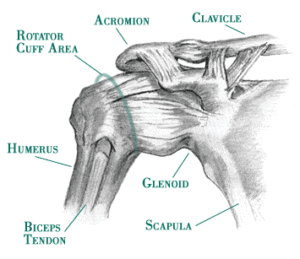
5. Eric Beard did a great overview of the shoulder girdle and the issues we face in this complex region.  From reading this blog, you realize that I could talk about all shoulders, all the time – so it was impressive that Eric crammed as much quality content into an hour as he possibly could.  I really liked his scapulohumeral rhythm images as well as his continued emphasis that shoulder injuries often take years to come to fruition; there are often just “incidents” that become the straw that breaks the camel’s back.

shoulder_anatomy_pict

If you’re interested in learning more about shoulder impingement, this webinar would be a great resource for you (along with my The Truth About Shoulder Impingement Part 1 and Part 2).

6. Dean Somerset was last, but certainly not least.  Dean spoke at length about the role of fascia in governing movement.  In the past, I’ve written at length about how we may have terrible x-rays, MRIs, or other diagnostic imaging – and be completely pain-free.  Well, as Dean discusses, we can have a boatload of pain, but absolutely nothing abnormal on these images.  In fact, 85% of lower back pain has no definitive diagnosis – so what gives?  Well, this is where fascia comes in.  We’re talking about the entire extracellular matrix of the body.  It’s proprioceptively-rich and incredibly strong – yet it doesn’t really get any of the attention it deserves.  Ever had annoying pain that went away with soft tissue work?  Here’s a rationale for “why” it went away.  For related reading, check out my recent blog post, The Fascial Knock on Distance Running for Pitchers.

All in all, Muscle Imbalances Revealed was an excellent resource that I’d highly recommend you view.  And, I think it’s particularly valuable because you can conveniently watch it from the comfort of your own home or office without having to spend hundreds of dollars on travel and accommodations while taking time off from work.  On an even cooler note, when I reached out to Rick and mentioned that I was writing this review, he went out of his way and provided a special discount offer for my readers.  You can check it out at THIS PAGE


Wednesday, April 15, 2020

Tone Your Tummy


Tone Your Tummy

 It’s the first system designed to start by making you healthy on the inside — both emotionally and through a strong and balanced core — in order to make you visibly healthy on the outside too! Tone Your Tummy works so fast and so well because it starts by restoring the energy blockages in your body, allowing you to utilize your abs muscles and develop a strong and beautiful core!

BUY NOW

tummy toning exercises

For those who hate spending hours in the gym working on their abs, we’ve got some good news: getting a strong core really doesn't have to take up a huge chunk of your day. We know it can often feel like there’s an endless number of ab exercises out there and sometimes it’s hard to know where to start. So we’ve put together a list of 15 effective moves that you can quickly knock out at home that will have your core feeling as strong as steel.

In fact, when you pair the right moves with clean eating (it's true what they say: abs are made in the kitchen), you can get the job done in as little as 10 minutes a day. Whether you want to tack these moves onto the end of a cardio workout, or do them solo, they’re sure to have you feeling super powerful in no time. And if you’re more of a morning person, just grab a mat and do these workouts as soon as you wake up so you can get on with the rest of your day feeling stronger than ever.

1 V Ups
  1. Lay on the floor with your legs fully extended and arms stretched out above your head.
  2. Simultaneously lift both hands and both legs up in the air, reaching your hands towards your toes, to form your body into a V shape. Repeat for 60 seconds.

Make it easier: Lift just one leg at a time, alternating sides.

2 Bicycle Crunch
 
  1. Lie on the ground with one leg extended straight out and one leg bent with your knee pulled in towards your chest. Both feet should not be touching the floor. Place your hands on the back of your head.
  2. Alternate bending and extending your legs, as if on a bicycle, while rotating opposite elbows towards the bent knee. Be sure to focus on fully extending your straight leg out.

Make it easier: Keep your hands down by your sides just cycle with your legs.

Advertisement - Continue Reading Below
3 Plank

1. Start on your hands and knees. Lower down so your elbows are on the floor, placing them directly underneath your shoulders. Extend your legs out, coming up on your toes and lifting your body into a straight line.

2. Squeeze your abs, glutes, and legs to stay in a straight line. (Be sure not to let your hips lift up or sag down.) Hold for 60 seconds.

4 Reverse Dumbbell Chop
  1. Stand with feet hip width apart, knees bent into a half-squat, and hold the dumbbell in both hands to one side.
  2. While keeping your core tight, stand straight up and raise the weight over your opposite shoulder, twisting your torso as you lift.
  3. Bring the dumbbell back down, repeat for 30 seconds, and then switch sides.
Advertisement - Continue Reading Below
5 Reverse Crunch
  1. Lie on the floor with knees bent and your hands underneath your glutes. Hold your feet up just above the ground with your toes pointed.
  2. In one swift motion, bring your legs in towards your chest and push your feet up towards the ceiling, lifting your glutes off the floor. Repeat for 60 seconds.

Make it harder: Add in an isometric crunch by placing your hands behind your head and lifting your shoulder off the ground while you continue the reverse crunch.

6 Plank Jack
  1. Get into a plank position with you hands slightly wider than your shoulders. Make sure your legs are fully extended and rest on the balls of your feet.
  2. While keeping your upper body still, jump your legs out and then back in. Repeat for 30 seconds.
Advertisement - Continue Reading Below
7 Stability Ball Mountain Climber

1. Place your hands 18 to 24 inches apart on a stability ball, then bring legs back so you're in a push-up position. (Your body should be in a straight line from head to toe.)

2. Keeping core tight, bring right knee to chest, then return to start. Repeat with your left knee. Continue alternating until you've done 10-12 reps on each leg, or complete as many as you can for 60 seconds.

Make it easier: Ditch the stability ball and do this exercise on the floor, starting in push-up position.

8 Flutter Kicks

1. Start lying down, hands by your sides, with your lower back pressed flat on the floor. Keeping your core tight, lift legs slightly off the floor.

2. Pointing your toes, bring one foot up, then the other, and repeat so they're fluttering without feet ever touching the floor. Continue for 30 seconds.

Make it easier: Place hands slightly behind your butt, making sure to still keep your lower back flat on the floor. (There should never be any space between your back and the floor, as that can lead to injury.)

Advertisement - Continue Reading Below
9 Standing Cross-Body Crunch

1. Stand with your legs shoulder-width apart. Keeping your left hand on your hip, reach your right arm overhead to a slight diagonal from your head.

2. With abs tight, lift your left knee to right elbow as you perform a standing crunch, then return to the starting position. Repeat for 30 seconds, then switch sides and repeat.

10 Long Arm Crunch

1. Start lying down with knees bent, feet flat on the floor. Straighten your arms back behind you, lightly clasping hands behind you.

2. Engage your abs and lift your shoulder blades off the floor, reaching up toward the ceiling. Slowly lower back to the floor to return to start. Repeat for 30 seconds.

Advertisement - Continue Reading Below
11 Side Plank

1. Start lying on your side, elbow directly underneath your shoulder and palm flat on the floor. Stack your feet, then lift hips up so your body forms a straight line. Hold for 30 seconds, switch sides, repeat.

Make it harder: After you're up in the straight line, lower your hips until they're just slightly above the floor. Quickly lift hips so you return back to a straight line. Repeat for 30 seconds, exhaling on the lift up and inhaling on the way down.

12 Side Squat Reach

1. Start standing with feet shoulder-width apart, toes facing forward. Push your hips back and lower into a squat, making sure your knees don't go over your toes.

2. As you push out of your squat and return to standing, twist your body to the left, bringing your right arm overhead to reach toward the left side. (Your weight will automatically shift to your left side, and your right foot should twist to the left as your body does.)

3. Return to center, lower into another squat and repeat, this time twisting to the right and bringing left arm overhead to reach toward the right side. Repeat for 60 seconds.

Advertisement - Continue Reading Below
13 Leg Lift

Start lying on your back, legs straight out and hands flat on the floor by your sides. Engage your core and lift legs off the floor so the soles of your shoes face the ceiling.

Keeping your lower back flat on the ground, lift your glutes up off the floor as if your heels are trying to touch the ceiling. Lower your glutes back to the floor and lower legs slightly (without lifting lower back off the floor). Return to starting position. Repeat for 60 seconds.

14 Roll Up

1. Start lying on your back, legs straight, lower back flat on the floor. Bring your arms straight overhead.

2. Flex your feet and tighten your legs. Inhale and lift your arms straight up. As you exhale, use your abs to curl your head, neck, and shoulders up off the floor. Lift all the way up and over your thighs, reaching arms out in front of you.

3. Slowly roll back down to the floor one vertebrae at a time until you return to start. Repeat for 60 seconds.

Advertisement - Continue Reading Below
15 Russian Twist

1. Start sitting on the floor, knees slightly bent, heels on the floor. Lean back slightly to engage your abs.

2. Rotate to the left, touching your fingertips to the floor. Rotate to the right, again touching fingertips to the floor. Quickly alternate back and forth for 60 seconds.

Make it harder: Lift your feet off the floor. To make it even more difficult, hold a medicine ball as you rotate.

Monday, September 09, 2019

Pleural Mesothelioma

Pleural mesothelioma is a rare cancer often diagnosed in people who have been exposed to high levels of asbestos. The malignancy affects the pleura, a thin membrane of lubricating cells that lines the lungs and chest wall. It sometimes takes ten years or more for changes to appear that are indicative of pleural disease, and even longer for symptoms to manifest. These differences can include a thickening or calcification of the pleural lining—a condition commonly diagnosed as pleural plaques. Conditions like pleural calcification or the development of pleural plaques often serve as precursors to mesothelioma.

In most instances, pleural disease is not considered fatal but it can cause diminished lung function and may confirm that a person has sustained significant asbestos exposure. Patients diagnosed with pleural conditions are generally considered to be at a higher risk for developing the more severe pleural mesothelioma.


Recognize 5 Types of Mesothelioma Cancer

Mesothelioma is an aggressive malignant cancer that affects the lining of the lining of the lungs and stomach, malignant mesothelioma or malignant mesothelioma is the most serious of all asbestos-related diseases. Although rare, mesothelioma cancer is no longer considered rare. The main cause and risk factor for mesothelioma is asbestos exposure.

mesothelioma has several types and can attack several parts of the body, including:

1. Mesothelioma pleura (lining of the lungs)
This type is the most common of all mesotheliomas. Usually caused by frequent inhalation of asbestos fiber dust, which is then trapped in the pleura and causes scarring and inflammation.

2. Peritoneal mesothelioma (membrane of the abdominal cavity)
The second most common type develops in the peritoneum, which is the tissue lining the stomach. Similar to pleural mesothelioma, the cause is dust and asbestos fibers that are either ingested or find its way into the digestive tract so that it settles and develops in the lining of the abdominal cavity.

3. Pericardial mesothelioma (pockets that surround the heart)
Mesothelioma is ranked third most often that attacks the tissue lining the heart. The cause is also asbestos, and this cancer develops from abnormal cells that have developed in the pleura. Somehow the process, but this asbestos dust can penetrate into the pericardium and develop in the lining of the heart.

4. Mesothelioma of the testicle of the tunica vaginalis (internal lining of the male sex organs) and 5. Mesothelioma of the uterine tunica serosa (internal membrane of the female sex organ)

These two types of mesothelioma are the most rare. Although it is uncertain how exactly asbestos dust can settle and attack the female sex organs of this man, but some cases do show that asbestos dust is the main cause.